
Businesses of all stripes continue to battle employee retention and turnover, but in the supply chain, it is particularly acute for a function that can define margin success for organizations.
A new survey from Gartner shows that more than half of supply chain executives say leadership turnover has “moderately to completely disrupted” their function’s ability to perform over the past three years.
In a global climate of rapid technological change and rising reliance on AI, this turbulence is shining a spotlight on the weaknesses of legacy supply chain leadership models and raising the stakes for companies that fail to develop a new generation of resilient, collaborative, and future-ready leaders.
Leadership turnover and outdated development pathways
Gartner surveyed 227 supply chain leaders in mid-2025, and found that 54% report that leadership turnover significantly disrupted their supply chain operations in the past three years. Just 22% of supply chain leaders exhibit “collectively motivated” behaviors. Gartner defines these are including cross-functional collaboration and team empowerment, and are behaviors that correlate with stronger business outcomes. The majority remain “individually motivated,” focused on personal performance rather than organizational success.
“Effective supply chain leadership has to shift from an overreliance on individual superstars, who our research has found are less collaborative, to leaders who are motivated and equipped to amplify the performance of their teams and organizations,” said Tess Frenzel, senior principal analyst in Gartner’s Supply Chain practice. “CSCOs who are able to adapt their leadership strategies to build these types of leaders and design the roles and development programs to help them succeed will improve supply chain performance, despite the disruption inside and outside of their organizations.”
Organizations are also feeling the pressures of new technologies and requirements, with 59% of respondents saying the broad and continually growing set of skills necessary for their positions make them hard to fill and maintain. Less than half (49%) rated their leadership-development programs as effective, suggesting current approaches aren’t keeping pace with evolving demands.
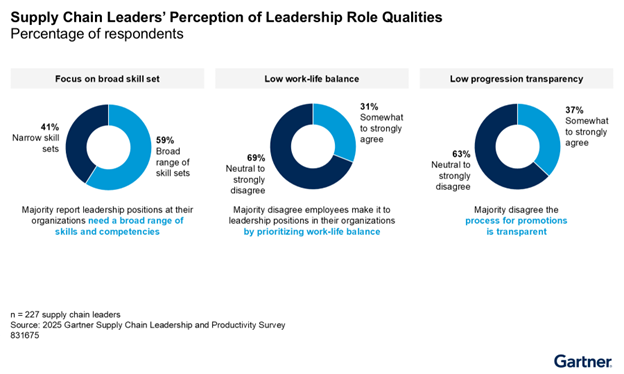
And this is taking its toll on morale. Just 31% of leaders say prioritizing work-life balance is part of the path to advancement, and only 37% say promotion processes are transparent.
As companies invest in AI, digital transformation, and advanced supply chain tools, many are realizing that technology alone won’t deliver unless leadership and culture evolve too.
Building future-ready leadership
According to Gartner, companies that want to thrive amid disruption must reimagine how they develop, reward, and sustain supply chain leaders. The firm identifies three key shifts:
- Develop and reward collectively motivated leaders. Move away from superstar-centric models. Instead, prioritize leaders who drive collaboration, cross-functional performance, and collective success.
- Combat role over-expansion. Avoid creating overly broad leadership roles. Define and scope roles carefully, align them with strategic priorities, and preserve realistic work-life balance to reduce burnout and turnover.
- Unlock agile leadership development. Replace static, one-size-fits-all development programs with dynamic, tailored training by using embedded learning, partnerships, and technology to keep pace with rapid change.
By aligning leadership development with these principles, companies can build a stronger bench of leaders equipped to handle disruption, lead teams through complexity, and adapt quickly to evolving conditions.
Why this matters
The supply-chain world is shifting fast as AI, automation, shifting customer demands, and geopolitical uncertainty are creating new challenges and opportunities, and leadership needs to keep up.
According to Gartner, high turnover directly undermines supply chain resilience, operational continuity, and strategic execution. It notes that the firms that get ahead already view leadership as a strategic investment and build development programs that reflect that mindset.
SC
MR


More Supply Chain Leadership
- The AI-empowered supply chain leader
- From operations to orchestration: The CSCO’s nexus role in a synergistic C-Suite
- Suppliers may evaporate, but leadership does not
- Leadership turmoil threatens supply chain resilience, Gartner survey finds
- Fixing the misalignment between supply chain leaders and the C-suite
- More Supply Chain Leadership
 Explore
Topics
Procurement & Sourcing News
- Why companies blame the wrong supplier … and miss the real failure
- NextGen Supply Chain Conference unveils agenda focused on AI, execution and the future of leadership
- From fragmented negotiations to coordinated negotiation performance: an AI-enabled approach
- Supply chain resilience isn’t a data problem; it’s a judgment problem
- Why your supply chain risk management plan will fail
- When component verification becomes operational
- More Procurement & Sourcing
Latest Procurement & Sourcing Resources

About the Author
Brian Straight, SCMR Editor in Chief

Brian Straight is the Editor in Chief of Supply Chain Management Review. He has covered trucking, logistics and the broader supply chain for more than 15 years. He lives in Connecticut with his wife and two children. He can be reached at [email protected], @TruckingTalk, on LinkedIn, or by phone at 774-440-3870.
Follow SCMR on social media.
@SupplyChainManagementReview on Facebook
@SCMR on Twitter
SCMR on Linkedin
Subscribe

Supply Chain Management Review delivers the best industry content.

Editors’ Picks



